Jeanne-Louise Dumont was born in Paris on May 31, 1804, at the Sorbonne. Originally a medieval college, the Sorbonne had by then been partly converted into living quarters and workshops for established artists and their families. The Dumonts were among the painters, sculptors, and engravers who lived there. Louise also practiced painting and drawing, but ultimately devoted herself to music. At six, Louise began piano lessons with her godmother, Cécile Soria, a former pupil of Muzio Clementi. Musical gatherings took place within the Sorbonne's artistic community, bringing musicians into contact with the artists and their families.
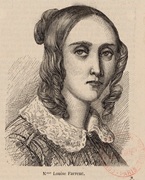 Among the musicians who attended these gatherings was Aristide Farrenc, a flautist and composer from Marseille. Ten years older than Louise, Aristide was studying at the Paris Conservatoire when their paths crossed. The couple married in 1821, when Louise was seventeen. Following their marriage, they travelled through France, performing together in concerts. They eventually returned to Paris, where Louise continued her composition studies with Anton Reicha. Reicha had known Beethoven during their youth in Bonn, where both had been musicians in the court orchestra. Aristide established a music-publishing business that published Louise's compositions alongside works by other composers. In 1822, his firm issued her Variations brillantes, Op. 2, based on a theme by Aristide. Three years later, he secured French publishing rights to forthcoming works by Johann Nepomuk Hummel, establishing a professional relationship that continued for years.
The Farrencs participated in Parisian musical gatherings. At one soirée hosted by piano manufacturer Jean-Henri Pape, they opened the program with a fantasy for flute and piano that they had composed together. Louise returned in the second half to perform variations for two pianos with composer Jérôme Payer. The program also included singer Maria Malibran and the young Franz Liszt, who joined five other pianists in a twelve-hand arrangement of Mozart's The Magic Flute overture. Music by Ignaz Moscheles was performed by a pianist named Rhein.
In July 1830, Louise organized a concert at the Salons Érard featuring music by Johann Nepomuk Hummel, who participated personally. Louise performed in Hummel's Military Septet, Op. 114, and played other compositions by him. The evening concluded with an improvisation by Hummel. A contemporary review in the Revue musicale praised her playing and serious musical studies, contrasting her approach with the fashionable emphasis on technical display.
The Farrencs' professional activities also took them abroad. During the early 1830s, Louise accompanied Aristide to England on at least two occasions. In correspondence with Hummel, Aristide reported favorable responses to her performances and agreements for the publication of her compositions. Their daughter, Victorine, was born in 1826.
Louise Farrenc's daughter Victorine was among her earliest piano pupils. Born in 1826, Victorine studied with her mother before entering the Paris Conservatoire, where she won first prize in piano in 1844, at eighteen. By then, Louise was teaching at the same institution. Appointed professor of piano in September 1842, she remained there for thirty years, instructing female students while continuing to give private lessons. Her appointment initially caused confusion in the Parisian press. The Journal des débats announced that "Monsieur Farrenc" had been appointed, then corrected the notice to identify Madame Farrenc. Le Ménestrel clarified that she had received a full professorship rather than an assistant's position.
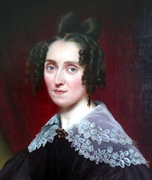 Despite holding a comparable position to her colleague Henri Herz, Louise initially received 200 francs less per year. In 1849, she wrote to the Conservatoire's director, Daniel Auber, requesting a salary increase. When the matter remained unresolved, she wrote again in 1850, pointing out that male colleagues appointed after her had already received raises. She requested equal compensation, arguing that the difference could suggest insufficient diligence on her part. By 1855, Conservatoire records show her annual salary had reached 1,200 francs, matching Herz's.
Farrenc took an active interest in piano instruction. In 1848, she proposed more demanding entrance examinations, including sight-reading and a prepared sonata by Mozart, Haydn, Clementi, Dussek, or Beethoven. She recommended an admission age limit of seventeen, restrictions on the length of study for students who did not enter competitions, and tighter rules for participation in those competitions. Between 1847 and 1868, however, nine students entered Farrenc's class after eighteen, compared with three in Félix Le Couppey's class and one in Herz's.
Her correspondence also documents her attention to former and prospective students. In March 1867, she wrote to a journalist after tickets intended for him had mistakenly gone to another publication. Her former pupil Marie Louise Mongin was performing, and Farrenc hoped he would still attend and review the concert. In October 1868, she wrote to the Conservatoire administration after a prospective pupil's mother insisted that her daughter study with another professor. Farrenc requested a replacement and objected to being assigned students rejected by the admissions committee.
Her students pursued careers as performers, composers, and teachers. Among them were Louise Béguin-Salomon, who subsequently taught at the Conservatoire; Hortense Parent, who established her own piano school; and Sophie Maria Sabatier-Blot, who composed an opéra comique.
 During the 1830s, Paris attracted musicians from across Europe. Franz Liszt, Frédéric Chopin, and Niccolò Paganini performed before audiences fascinated by virtuosity, while opera continued to dominate the city's musical life. Piano manufacturing, publishing, and public concerts also developed during these years. Farrenc's compositions increasingly extended beyond the piano. In 1834, she completed two orchestral overtures. During the following decade, she composed three symphonies, alongside chamber works for piano, strings, and wind instruments. The Société des Concerts du Conservatoire, founded in 1828, provided an important venue for orchestral music, particularly works by Beethoven and other established composers. On April 22, 1849, the Société performed Farrenc's Third Symphony in G minor, Op. 36.
Farrenc also composed substantial chamber works, including two piano quintets, piano trios, and sonatas for violin and piano. On March 19, 1850, her Nonet in E-flat major, Op. 38, received a public performance at the Salons Érard in Paris. The ensemble included the nineteen-year-old violinist Joseph Joachim, cellist Charles Lebouc, double bassist Achille Gouffé, and flautist Louis Dorus. François-Joseph Fétis reported an audience of more than four hundred and reviewed the composition favorably.
 Farrenc continued writing chamber music throughout the 1850s, including works for clarinet, flute, cello, and piano. Her contributions received recognition from the Académie des Beaux-Arts, which awarded her the Prix Chartier in 1861 and again in 1869. Alongside these larger compositions, Farrenc developed a substantial body of piano music. During the 1830s she composed Trente Études dans tous les tons majeurs et miners, Op. 26, published around 1839 and dedicated to Sophie Bodin. The thirty studies cover major and minor keys and address technical and musical demands. In an 1840 review, Maurice Bourges praised their contribution not only to technique but also to musical taste. In 1845, the Paris Conservatoire adopted Op. 26 as required piano repertoire.
She subsequently composed three further collections: Douze Études brillantes, Op. 41; Vingt Études de moyenne difficulté, Op. 42; and Vingt-cinq Études faciles, Op. 50. These works provided material for pianists at different stages of development, extending the relationship between composition and instruction that occupied much of her professional life. Among the shorter works is the Étude in A minor, Op. 50, No. 2, from Vingt-cinq Études faciles. Written for developing pianists, it belongs to the repertoire Farrenc created not only as a composer and performer, but also as a teacher whose music continued to serve the next generation of pianists.
ReferencesHer oeuvre contains some substantial works for Orchestra, plenty of Chamber music, and some Choral and Vocal music. However it is the Piano that is strongly associated with the Composer and her output.
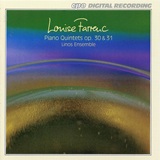
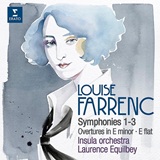
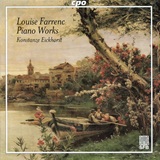
If you subscribe to a music streaming channel, then that is the best low-cost way to start exploring Louise Farrenc's music. But much of her music is available on CD with the following being readily available on Amazon:
The final album above contains a selection of Farrenc's piano works. However there is also a set of 6 volumes of her Piano Music called "Louise Farrenc: Complete Piano Works". These are divided into Vol.1: Etudes, Vol 3: Rondeaux, Vol.5: Fugues, Melodies, Valses, qand Volumes 2, 4 & 6 are all dedicated to her "Theme & Variations" works.
 mfiles home
