Some observers take it as a sign that film music as an art unto itself has finally taken its place amongst any other musical specialty as they note that a distinguished academic publisher like Oxford University Press has released fully five text books on that subject, just in this year 2025 alone. At the same time, it is no longer unusual for colleges and universities around the world to add major coursework to their curricula examining the history and aesthetics of movie scoring and offering degrees in the field – all this as soundtrack music, the specialty subgenre, supports its own popular audience through recordings and downloads. Of course, it has always been true that the movie theater is where a good many ordinary people have gotten their first experience with sophisticated orchestral music and so it stands to reason they would be curious enough about the subject to want to read something about it away from the screen, something about the composers who write for films and about the whole process: about how and why it's done, about who are the more exciting practitioners, and about whether it can be studied for its own value, away from its original screen contexts. And indeed, books on those subjects are coming out all the time now. 2025 is a case in point.
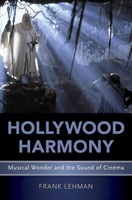 Ten highly visible film music-related books that have appeared throughout 2025, summarized here, can represent the lot, some of them coming from the most unexpected quarters. Oxford University Press, as we have said, is responsible for half of those ten and they are titles of varying value. Hollywood Harmony by author Frank Lehman successfully addresses the subject of soundtrack music from two angles with a subtitle that points both to the content and the contexts of what makes a good film score, promising to explore "musical wonder and the sound of cinema". In 312 pages, author Lehman takes on the whole subject with an equal eye to both aspects of the successful film score: its use as both an illustrative and a narrative tool. It is considered a plus, then, (not a requirement) if that same music can also rise to the level of legitimate listening, not intended to, but able to, stand alone.
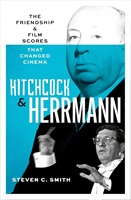 New books from the Oxford Press have also tackled the subject of individual film composers this year: witness the venerable Steven C. Smith's new study Herrmann and Hitchcock: The Friendship and Film Scores That Changed Cinema. As he did in his 1991 Herrmann biography, A Heart At Fire's Center, Smith draws a sympathetic portrait of the erratic, eccentric Herrmann and here mixes it with the obsessive, eccentric behaviors of the "master filmmaker of suspense" Hitchcock, both as director and as colleague. It's both a detailed intimate account of the films they did together and a record of, at least a speculation of why the relationship ended so nastily. At times, this seems somewhat lurid territory for Oxford University to even be bothering with, but Smith holds to the aesthetics of it and a rather valuable lesson in collaboration-corrupted-by-commerce results.
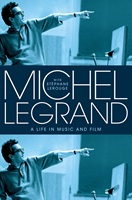 Similarly, French critic Stephane Lerouge's interviews with and thoughts about Michel Legrand (A Life in Music and Film) doesn't shy away from the rocky periods in the composer's always impatient, energetic career on both sides of the Atlantic – director Jacques Deray's rejection of Legrand's progressive jazz/choral scoring for 1971's La Piscine or his orchestral score to 1976's, Richard Lester film, Robin and Marion. "Even though I've done symphonic concerts", Legrand is quoted as saying, "I've often given more thought to my cinema scoring. I adore mixing them up Safe music bores me. If you expect no surprises, then it's no use calling me. Even if it means that some filmmakers turn my scores down, it doesn't matter to me. At least it proves you're alive". Oxford, at least, seems to relish the discussion.
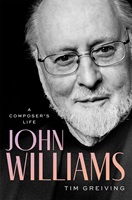 And not neglecting the most prominent film composer in the world today, Oxford also offers its own representative book this year on the career of John Williams: A Composer's Life by Tim Greiving, formerly of USC. At 640 pages, it is a gathering place for Williams' career information and, in the quoted words of some fans and colleagues, a record of the respect in which he is seen. It's also a brief look at what Hollywood was like in that crossover period between the old studio system and the blockbuster era where single film franchises (helped by their adjacent music sales which could be counted on as an effective promotional ambassador for each film) were often earning more than whole studios could muster in previous times. Producers, sponsors, and audiences alike were becoming aware of those so-called "background" music scores like never before. Books about the phenomenon are the continuing proof.
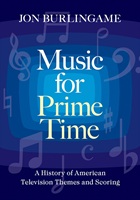 One other industry that has joined this sort of musical awareness and this year got a definitive book to represent it is the television industry as Oxford announced Jon Burlingame's 450-page history of American TV Themes and Scoring, Music for Prime Time. It's a meticulous record of television background music from the very early days when TV series were scored with individual cues from a standing library of past orchestral recordings selected for mood and timing only, through the era when later shows received specifically composed cues inserted at each dramatic point in the episode. Burlingame's book also stresses the importance of composing a single and singular theme cue by which each series could be recognized and then leads us through most of the classic examples, divided into genre categories like westerns, detective series, comedies, documentaries. Attention is also paid to music in cable and streaming services and for certain British fare that has been seen in the US. In one way, Music for Prime Time is just a vast updating of Burlingame's own 1996 volume, TV's Biggest Hits, which had broached the same topic at half the length.
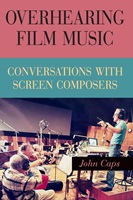 One other university press book out this year on movie composers, Overhearing Film Music, is basically 400 pages of prominent composer interviews (SUNY Press: State University of New York) – transcripts of conversations with the likes of Elmer Bernstein and Henry Mancini, David Raksin and Miklos Rozsa, Rachel Portman and Laurence Rosenthal, also incorporating separate essays on Williams, on Goldsmith, on Black Composers for Film and on the role of Women Composers which steadily increases in our time. SUNYs attempt in this book has been less to present the formal newsprint kind of Q&A in front of a dozen top composers than to reproduce a free-wheeling conversation session with each composer about the goals, the skills, the mystique, and even the moments of self-expression that a fully successful film score can accomplish: composition making its own musical points AND helping tell the story on screen at the same time.
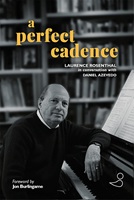 This survey started with the observation that Oxford University Press was perhaps an unexpected venue to be supporting and exploring the pop-topic of film music. But the most recent volume in this discussion comes from far farther afield: another composer interview transcript -- this one recorded in Switzerland but published in Rio by Brazilian medical doctor, Daniel Azevedo, who is also a lifelong fan of certain film scoring composers and was motivated enough and well-informed enough to translate his own musical interests into this 300 page volume from publisher Letra e Imagem, called A Perfect Cadence: In Conversation with Laurence Rosenthal -- five days of interviews with the then-nearly 98 year old composer of Becket and Young Indiana Jones -- and because Rosenthal has lived through so much of what led up to now, their conversation becomes a kind of narrow record of cultural history during that time – from the composer's student days in Paris, through the avant garde period in music, into the eclectic styles and genres that are required nowadays when writing for the screen. Along the way, Rosenthal puts his vote in for writing "real music" even though it has to be functional too. "The best screen music will have a life of its own", he says to Azevedo. "If all you do is write a compliment for what's already on the screen, nobody will be interested in hearing it... But if (later) it lives and breathes on its own, it's real music. That's what I've tried to do all my life -- to write real music." The maestro dispenses a few non-musical lessons as well – one important one for the film composer: "Don't fall in love with your material because it can often get thrown out by a producer. Nice music that just doesn't play well against the scene on screen will be scrapped." And all through their sessions together, Rosenthal's quick and complete memory, even at this advanced age, and Azevedo's knowledgeable and sympathetic questions, make A Perfect Cadence a rare and happy read. An additional plus is the fact that Rosenthal has lived so long and so well, this long conversation ends up covering a lot of authentic 20th century cultural history.
Three final film music books can be mentioned here from semi-private, relatively limited publishers:
Any one of the ten books in this limited survey, while teaching a brief history of the soundtrack scoring art, can do as much of the How To (compositional technique), When To (where music should go in a film and exactly when it should be out), and Why To have soundtrack music helping to tell the story on screen. Ten new books, all released in 2025, full of insight, lessons, examples, methodologies, and history. Together they stand as ultimate proof that film music as a specialty art has earned its status in the overall music field – maybe the most effective and memorable single element in the whole toolkit of cinematic storytelling. It's good to see the publishing industry agrees.
-- One addendum to the list of three independent book titles at the end should clarify that Stephan Eicke's helpful how-to book from McFarland, "The Struggle Behind the Soundtrack", though heavily promoted this past year was actually published in 2019. His important new release for this past year comes from Bloomsbury Academic Press: A Dream Come True: The Collaboration of David Lynch and Angelo Badalamenti. Check it out.
Note: All links and book images in this article should open a new tab at the relevant product page on Amazon.co.uk (or your local Amazon site if Amazon is able to redirect the link). From there you should be able to determine and select the appropriate format: hardback, paperback, electronic, etc.
John Caps has written on music for High Fidelity/Musical America and the New York City Opera; and on film music for Film Comment, Film International, National Public Radio, The Cue Sheet, and the University of Illinois Press's "Music in American Life" series. His most recent book is Overhearing Film Music: Conversations with Screen Composers from the SUNY Press (State University of New York).
 mfiles home