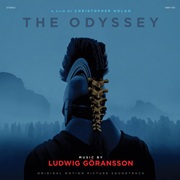
 In the same way that Christopher Nolan's 2026 epic film, The Odyssey, when it opened to much fanfare and debate, was said to be about more than Greek mythology, having implications for (even lessons for) our restless world, so too the soundtrack music score by the Swedish/LA composer, three-time Oscar winner, and rock-pop producer Ludwig Göransson, carries its own implications past the usual music-making job of any soundtrack, perhaps even suggesting a future common style for film scoring. For, although traditional plot lines are not really represented within this film score, there IS an observant sense to the slowly advancing soundscape that Göransson has compiled here – it is scoring that de-emphasizes themes or sequential musical development and has abandoned altogether the usual symphonic orchestral forces often associated with epic films like this. He clearly has only anti-epic music in mind. I can't say that the score we have here as a result should come under a heading of mere Sound Design instead of music composition, but listen to what we do have: an ensemble of unfamiliar but evocative instruments playing in a limited mode of Greek harmony, intending to evoke the setting of ancient Athens and adjacent civilizations thereabouts circa 12th century BC but using ethnic sounds and scales and motifs rather than themes or even bits of folk music.
For the typical big-budget epic film of war and weaponry and heroes these days, we have come to expect aggressive militant music scores such as John Williams has provided for Star Wars or, for that matter, as Göransson himself wrote into some of the adventure scenes in his Oscar-winning music to Black Panther (2018). No-nonsense superhero fanfares were a part of that soundtrack for sure, but as a student of both the Stockholm Royal College of Music and, by 2007, of USC, Göransson also wanted to provide a studied ethnic edge to the Panther score, and so he travelled all the way to Senegal to study up on African instruments and rhythms, searching out new modes and meters. Well, the musical habits of ancient Greece were no less foreign to him than African drumming and so for the new Greek odyssey he brought together a diverse team of ethnomusicologists to help his research, experts in ancient Mediterranean music of the Bronze Age, and he was quick to discover what scales and what instruments they used way back then: obsolete tone-makers like the aulos (a double-reed pipe with finger holes and a polyphonic range); the seven-string harp-like ancient lyre, the fyell-brezi shepherd's flute, a whole informal percussive ensemble of bells, gongs, and drums – and an all important foundation of twenty additional musicians who would provide background drones in different keys atop which individual instruments could solo. Finally, a small chorus of human voices making primitive guttural sounds at first, then delving into socalled iso-polytonal vocalizing, was recommended to Göransson as a final authentic element in the music of that Athenian age they were hoping to emulate here. Indeed, such an assembly of specific elements eventually did fill-out the soundtrack recording sessions -- everyone working off of Göransson's carefully assembled but freely created (and always open for revision) score pages. Everything was in place.
 He had discussed with director Nolan which scenes of this massive movie could use scoring of some kind but they were really imagining a more general kind of correspondence between screen and score rather than much direct framing or accompaniment. Musically, in approaching the soundtrack of this huge production, Göransson swore loyalty to a strict ancient dialectic of tones and drones in the narrow range of what harmonic scales seem to have been in common use in ancient Greece. His first experiments featured layers of tonality – discovering how often they relied on those single-note or single-chord drones as a foundation for solo instruments to play against, the whole passage interrupted, perhaps, by sudden piercing percussive sounds which then could become a regular pulse. Still, he was avoiding any use of outright melody: that seemed a later Western interest. Sparse, laconic motifs are the composer's chosen language here, framed by functional dramatic or contemplative passages that work as general scene-setting or transitional material. One typical cue, an aural portrait of Odysseus's home district Ithica, is drawn first by a major-key motif, G-A-B-A, atop of warbling drone in the aulos. Deep harp notes reinforce the same G-major foundation. The score so far is still not thematic in nature and yet, in the words of director Nolan, it HAS managed to declare itself "against all reason, cohesive and inspiring!" To some extent, this is like listening to actual history (the authentic instruments have a charisma all their own) but, of course, it's not history at all – it's mythology from an epic poem by Homer "starring" the contradictory character of Odysseus, admirable in his prosecution of the Trojan War and his famous plot to smuggle his army behind enemy lines hidden inside a giant wooden horse – but unconscionable in the wholesale slaughter he would cause. Nolan's Odysseus is no simple Hollywood hero, either, but a complex figure of his times, his contradictory character being presented here (so says the New York Times in reviewing this film and its contexts) as a comparable perspective on our own worldly ways -- identifying the true motive behind the Trojan War to be, not the defense and rescue of the fair maiden Helen, but a political grab for dominance over ancient trade routes – and comparing such duplicity with our own global-greedy politics.
In Nolan's scenario, then, this is as much a moral tale as an adventure/fantasy. Sure, our hero's strength and success is going to be measured by his wins in the external world of battle and there is even a fantastical Cyclops monster to deal with out there somewhere, but there's a powerful internal issue to face as well and Nolan's Odysseus is beginning to sense it: it is the moral imperative they are calling Zeus's Law -- the timeless responsibility that we all share to "treat the stranger (even one's opponent) as you would want to be treated," judging others as equals. That is supposedly what this epic script is underlining – a dual odyssey of outer-and-inner wars. But what sort of narrative soundtrack music could possibly underscore such an earnest ancient polemic without sounding either overwrought, ignorant or old fashioned melodramatic? This, then, was the composer's anti-epic task.
 When old Hollywood used to dramatize these ancient myths and histories, the sword-and-sorcerer romances, they were always decorated with splashy symphonic soundtrack scores working hard to stoke a spirit of importance, of melodrama, hoping also to touch upon something in the exotic setting of each story. Why, this very tale of ancient Greece has already been entertained in a big 1950s film starring Kirk Douglas called Ulysses
(1954) where an epic soundtrack score by Alessandro Cicognini lent a big-budget sound to the film but could never quite overcome the bargain-sale feeling of a B-movie because of the scoring's so obviously forced authenticity and anachronistic melodies. But what of this 2026 version? Both Nolan and Göransson stood back from the obvious and, at least in the music score, chose to go against the epic nature of war movies, first denying the usual directly-narrative kind of orchestral composition that reinforces the action on screen like an escort -- then, second, choosing to emphasize and personalize the era itself by compiling a studio full -- a near museum full -- of ancient musical instruments, authentic sounds and scales and rhythmic schemes of the Bronze Age Mediterranean culture which was their backdrop. It's an organic way to accompany drama: authenticity is not quite the right word, for the score doesn't include any actual Bronze Age quotes that I know of -- but the music does show how both composer and director went to a lot of trouble to consult such figures as the ethnomusicologist Vasil Tole in search of ancient instruments and their playing styles circa 2500 to 1000 BC. For Göransson, these fairly primitive music-makers – the pipes and harps and gongs and
drums -- had just the kind of rough, natural, and hoary voices he wanted to speak for ancient times – organic enough to seem indigenous to the setting on screen but also musical enough to fulfill an abstract role as part of the ensemble producing the dramatic background score.
 The Odyssey score as it exists today as a whole, even apart from its film, heard on a two disc CD set issued through Back Lot Music LLLP, presents as a canny combination of such primal solo instruments, piped and plucked and struck, playing on top of various drones crawling forward in what is a kind of progress but which doesn't follow any sequential path. Still no outright themes appear as this film goes on, and yet you CAN begin to recognize a few recurring motifs of just three or four notes which gradually, even unconsciously, start to serve as narrative helps because of the way they become associated with some specific story element or character or location: for example, there is an early motif attached to Odysseus's hometown region of Ithaca, being a warbling tonal figure for aulos playing against a steady drone and giving the impression of a busy city-state where our hero once learned the ambitions of the warrior; there is a more tender motif for Penelope heard on some oboe-like instrument against an even more sympathetic harmony in thirds, perhaps four bars in length, which returns several times throughout the film -- almost but not quite taking on the profile of a "theme". Familiar musical phrases like these do tend to tie the scoring together, though, and take on the feel of a narrative. Even this late in the film, we are still repeatedly being introduced to new sounds, often unidentifiable to us: ancient brass gongs and clickers and whips, flat-surfaced wood blocks for scraping, different weights of handbells, a myriad of reed instruments that required the hiring of an ethnomusicologists just to sort them out; and an eventual human choir of some twenty-eight studio singers to perform what is essentially Albanian isopolyphonic music. Like much of the instrumental score we are sampling here, the singing of this wordless chorus consists of a sustained drone note (that's the "iso") and the semi-theme (three soloistic polyphonic voices) on top of it.
These elements, the few familiar motifs when they appear, together with the already limited range of the ancient Greek scales, are likely chief reasons that this whole score is managing to achieve its sense of continuity and its even indirect narrative thrust. In comments and interviews after the fact, both Nolan and his composer have shown their awareness of how generalized and indirect has been the correspondence between this scoring and its film. "A lot of the film's longer scoring cues," Göransson has said, "were NOT written to picture. In fact, when I experienced the film the first time, I was absolutely floored by how seamlessly the music fit the picture, just naturally. Although we still had an enormous amount a work ahead of us, I was relieved." Well, of course there would be some kind of correspondence between a non-interpretive ambient score like this and any kind of happenings on screen – two formless impulsive entities will often appear to match on purpose. And yet, this is a fascinating kind of match the deeper you listen. Hear a cue called "Loyal to the Future" – high pointillistic notes over warm harmonies seem to be a harbinger for some hope beyond harsh Greek history/mythology and an attempt to maybe come up with a theme – but then a subsequent cue called "Sirens" turns drone-like again into a bed of D-major.
I guess if there is a concerted effort to present a theme in this score, it would be the thunderous but enchanted cue called "Another Name" in which the choral forces proclaim a reverent semi-theme -- a kind of Odysseus Lament heard first as a plaintive call from two aulos, then taken up by additional layers of harmony from a blurry ensemble. But this is still only a two-bar phrase, hardly a theme; basically just the repetition of two-notes but developing harmony, growing in intensity into a three-minute drama of its own, still not thematic – or is it? Can this be called a melody? At just two notes, is it even composing per se? Even the one piece especially marked out as a "song" in this score -- the vocal "When I'm Home" penned by Göransson and James Blake – is this thematic in any accepted sense? Much of this could be called ambient scoring which, while it doesn't specifically underline action on screen, does set up a frame around it, and proceed alongside it.
 That very sense of accompaniment, together with the unique effect of those historic Greek instruments and the whole story of the personal research regimen that the composer has put himself through have been reminding me of another screen composer who famously went exploring into his own cultural roots in search of, in this case, the ancient sounds and scales of Japanese music for similarly ambient scores to the major films of Kurosawa and others – this is the prolific concert composer Toru Takemitsu. His research led him to apply a whole host of ethnic instruments to his own film soundtrack composing throughout the 1960s, '70s, '80s – instruments both strummed and plucked like the three-stringed koto or piped like the biwa or the bamboo flute shakuhachi. And like Göransson, Takemitsu sometimes had those ancient sounds (and ways of playing) altered electronically, adding another layer of abstraction. Some films he encountered were obvious candidates for this ethnic scoring: in Kwaidan (1964) a biwa player was actually pictured on screen as part of the plot so that the solo flute-playing became important for the rest of the ambient score – whereas for the symbolic dreamlike black and white film Woman in the Dunes (1963) Takemitsu brought together groups of percussive instruments such as bamboo tubes, flatwood slats, and taiko drums, to mimic the dry scratchy grains and rivulets of sand that were the obsessive setting of the film; then subtle cluster chords from an ensemble of strings to delve into the purely symbolic human characters trapped there…the whole soundtrack having an overall ambient influence rather than declaring any specific match-ups.
In certain films, Takemitsu would admit at least a general "hosting" of the story on screen by his music score: for the Shakespearean pastiche called Ran[Chaos](1985), a Japanese dynastic version of the play "King Lear," he brought in the weight and formality of a symphony orchestra to mix with ancient Japanese instruments creating a large-scale soundtrack scoring that allowed some directly descriptive symphonic crescendos and pauses and exclamations. This certainly required a full-fledged fully schooled composer to achieve, not just a so-called sound designer. But in the end Göransson's Odyssey CAN often seem just as illustrative and therefore just as specifically composed as anything by Takemitsu, if not by formal developmental composing, then by virtue of its own internal expressive qualities, the plain sonic fascination of these ancient instruments collected for the soundtrack -- and the composer's fine instincts for choosing, blending, applying and framing the unique sounds they make.
Still, I can't forget that in "another life" maestro Ludwig was a rock music producer rather than a composer, although he has had all the schooling a "real" composer needs. I keep asking, though, not on behalf of film music itself but on behalf of other so-carefully and formally composed soundtrack scores that I know and admire for the sheer skill and traditional scholarship they represent: Can one particular, insular and merely motivic score like this be held as formal composition?? It's been a debate that has coincided with my recent study of one opposite type of scoring for an equally epic production, also from Britain, the work of the veteran concert composer and cinephile, Sir Richard Rodney Bennett for a BBC multi-part epic set in another wholly mythic universe called Gormenghast. This is formal traditional orchestral music that absolutely hangs together as a single evolving composition, even a most personal expression of its creator.
While it is largely unfair to compare one independent work of art with any other, especially knowing how one film's needs are so different, I can't help but do some genuine soul-searching comparison between this relatively recent British gothic epic score by Bennett and this new ambient Greek model of scoring I am questioning herein. Just as sheer composition, let alone how deeply the music pursues its drama on screen and how deeply and personally it also seems to express the mood and mindset of its composer, RRB's Gormenghast must be the finest, most solid piece of film music I've heard in the last couple of decades. But how does such a traditional score like that, however impressive, stand up against this new Greek experiment, the Göransson production style, however unique?
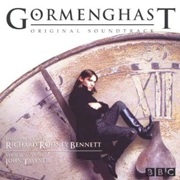 Gormenghast is a fantasy tale with elements of both English Gothic (its setting a run-down mythic medieval castle, its characters a fading corrupt British line-of-succession still in residence there) and an air of exotic oriental decorum reflecting the Asian influence of writer Mervyn Peake whose nightmare world this is. In the main storyline of this eclectic fable, young Titus, heir to the Gormenghast fortune, has said he wants
nothing to do with the family and sets off on his own, leaving behind an ambitious and suspicious kitchen-boy of the castle, the evil Steerpike, to scheme for control of what's left of the legacy, both the fading wealth and the broken castle itself. Bennett's score opens with a fanfare-like solo for boy soprano and orchestra to set an apostolic tone and the first main motif of stacked 5ths creates an atmosphere of portent and concern, soon proceeding through divisions and expansions, inversions and manipulations, into a saraband of low slow musings on that same material, ever more deeply, more intimately, for an orchestra of strings and horns – all of it thematically modal but moving us along a line towards a minor key as though the whole score were meant to be a single essay on the sober subject of, let's say, how anyone's vulnerable self can survive the Steerpikes of this world.
This brilliantly scored orchestral work as a whole, all the more profound for being subtle and relatively contemplative in nature (except for a couple of battle cues and one gorgeous French waltz for the Irma character) carries on into an E-minor focus. Maybe Bennett IS applying his music here a little more directly in service of its film than an ambient style would dare: note how he so movingly starts an emotional shift in the film's "Ceremony in the Rain" sequence from the score's overall troubled mood in a minor key (music of regret, of lost souls) to a new spirit in a major key, a feeling of "let's begin the world anew" as clouds part over Gormenghast castle. But realize, now, how it has been this vivid, traditional orchestral composition that has made this change convincing. Perhaps this kind of composition IS superior or more lasting than the Odyssey-style ambient scoring. Is one approach inherently more effective as cinema music than the other, though; more narrative in effect for all its specific interpretative influence over each scene, each character? I can't say so.
My surprise in getting to know Ludwig Göransson's music for The Odyssey is that, for all its reliance on tonal gestures instead of themes and ancient culturally-relevant instruments rather than sheerly musical ones, the score does seem to have a narrative thrust as a whole and does succeed in lending a convincing ethnic authority to the storytelling. Even in its blind representation as a set of music CDs it seems to hold together as a single work, speculative and exploratory in an original voice but, as an odyssey of its own, genuine composition – not so much an active driver for its film but certainly a fellow traveller.
The The Odyssey score album is available at Amazon.co.uk and Amazon.com.
 mfiles home
